 [Content moved from http://photographingtransitofvenus.wordpress.com/]
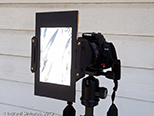
In my previous post, I mentioned my reasons for ordering the Baader AstroSolar film in preparation for photographing the transit of Venus. In this post, I will describe the process that I adopted for making a solar filter. The filter can be fitted to any D-SLR lens using a standard Z-PRO Cokin ND filter holder. My design choice was primarily dictated by the fact that I will be using my D-SLR with a telephoto zoom lens (most likely my Canon EF 70-300mm f/4.5-5.6 IS USM) instead of a telescope, and I already have the Z-PRO filter holder. The Baader film came with instructions on how to construct a Filter Cell for using any telescope; you could also follow their instructions to construct your own filter. I don’t think, from an image quality standpoint, that there is any fundamental difference between the two ways of mounting the filter in front of your lens. Their recommended way is suitable if you are using a telescope, or you don’t have a filter holder like one mentioned here.
The picture below shows all the material that you may need (I actually ended up using a blade too and didn’t use the gloves at all) to construct the filter. I was extra careful not to touch any part of the film with my figures. Things to note in the picture are two 4×6 size photo mat that I bought from Michaels, the AstroSolar film (unrolled slightly), and the Z-PRO Cokin filter holder on the top right.
 On June 5, (or June 6, depending on your Geo-location) the lovely and beautiful Venus will pop up in-between the Earth and the Sun, eclipsing a tiny portion (1/32 the size of the solar disk) of the Sun. The rarest of all eclipses, known as the “Transit of Venus,” last happened in 2004. So, you may think — why is it labeled “rare,” as it is repeating after only 8 years (not so significant compared to the average human life-span)? Well, it is predicted that the next transit will only happen again in December 2117 which is about 105 years from now, making this transit of Venus the last one of this century. As it turns out, this rare celestial event is also one of the most accurately predictable one! The transits happen in pairs which are separated by 8 years and the pattern of paired-transit itself repeats every 243 years.
 The last time I pointed my camera towards the Sun to photograph the


 Indranil's world